Registrar training in trauma and orthopaedics: Not a straight line, but still worth it
By Umair Khan
Specialty Trainee (ST5), Trauma & Orthopaedic Surgery, Northen Deanery
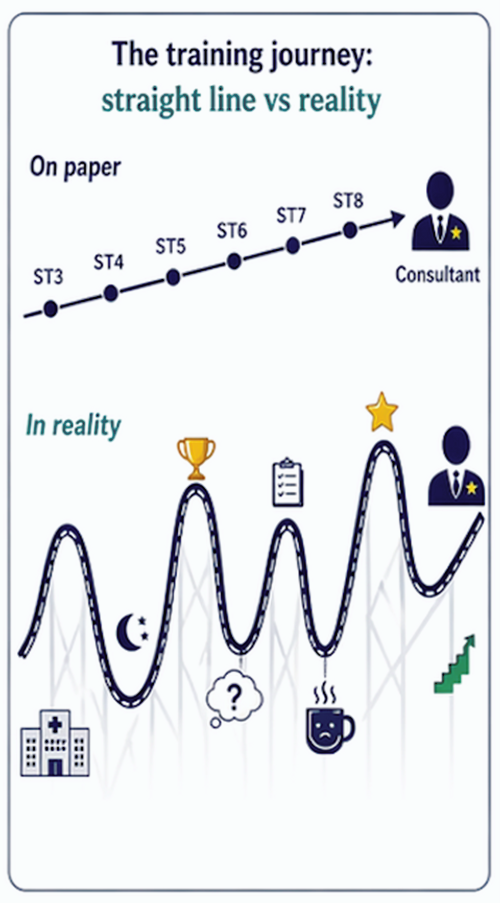
On paper, higher surgical training in trauma and orthopaedics appears to be a steady progression from ST3 to consultant. In reality, the journey is far less linear. It is shaped by steep learning curves, service pressures, exams, setbacks, unexpected wins, and the personal growth that comes from preserving through all of it.
The training pathway in trauma and orthopaedics is often presented as a neat sequence of stages: ST3, ST4, ST5, ST6, ST7, ST8, then consultant. That structure is helpful, but it can also be misleading. For many registrars, the lived experience of training feels much less like a straight line and much more like a rollercoaster.
Each year brings new rotations, new expectations, and a new level of responsibility. One week may bring the satisfaction of a great case, an encouraging supervisor, or a sense that your operating skills are finally clicking into place. The next may bring nights on call, exhaustion, self-doubt, missed opportunities, or the familiar pressure of portfolio deadlines, ARCP requirements and exam preparation.
Orthopaedic training is demanding not simply because of the technical skill it requires, but because it asks trainees to balance many parallel identities at once. Registrars are simultaneously surgeons in training, service providers, teachers, researchers, auditors, mentors, and learners. Success is rarely about moving forward in a smooth, uninterrupted way. More often, it is about continuing to show up, even when progress feels slow.
The emotional side of training is less often acknowledged, but it matters. Burnout, imposter syndrome and frustration can sit alongside moments of pride, camaraderie and genuine joy in the job. Most trainees will recognise that contrast. They will also recognise how important support can be: colleagues who help after a difficult on-call, consultants who create learning opportunities, and peers who remind you that you are not the only one finding it hard.
There is, however, something uniquely rewarding about the journey. Every patient teaches something. Every difficult shift builds resilience. Every setback refines judgement. The experience is cumulative, even when it does not feel linear. Looking back, many of the hardest periods are also the ones that shape us the most.
Perhaps that is the message worth sharing more openly with medical students, resident doctors and fellow trainees: orthopaedic registrar training is not meant to feel easy all the time. It is challenging, uneven and at times overwhelming. But it is also full of growth, purpose and moments that remind us why we chose this specialty in the first place.
So yes, on paper the pathway may look like a straight line. In reality, it is full of peaks, troughs and unexpected turns. But for those willing to going, it remains a journey worth taking.