
Hacking your training: Artificial intelligence in trauma and orthopaedic surgery
Authors: Rosie Hackney and Emily Baird
Hacking your training: Artificial intelligence in trauma and orthopaedic surgery
Rosie Hackney is an Orthopaedic Registrar based in Edinburgh, with a specialist interest in upper limb surgery. She has a particular interest in global surgery, surgical education and the use of information technology to improve training and clinical care. She is involved with Project Kuyenda, a charity working to strengthen orthopaedic education and service development in Malawi.
Emily Baird is a Consultant Paediatric Orthopaedic Surgeon at the Royal Hospital for Children and Young People in Edinburgh, with an interest in paediatric trauma, and congenital conditions of the hip and foot. She trained primarily in the West of Scotland with Fellowships in Edinburgh and Toronto. Emily is passionate about increasing diversity and inclusion in the workforce and broadening access to orthopaedics through mentorship and medical education. She has been heavily involved in providing medical student education locally and Post Graduate Education as Training Programme Director for Orthopaedic Trainees in South East Scotland, Examiner for the FRCS Tr & Orth and non-technical skills for surgeons faculty member.
The FRCS Examination
The Intercollegiate FRCS (Trauma & Orthopaedics) examination remains one of the most demanding assessments in surgical training. Success requires far more than factual recall. Candidates are expected to demonstrate judgement, prioritisation, safe decision-making, higher-order clinical reasoning and the ability to communicate clearly under sustained scrutiny. Traditional preparation methods – textbooks, viva courses, peer rehearsal groups and consultant mentorship – remain central to success. However, the rapid emergence of generative artificial intelligence (AI), particularly large language models (LLMs) such as ChatGPT, has introduced a new adjunct to orthopaedic education.
The question is no longer whether trainees will use AI, but rather how it can be used responsibly, effectively and safely.
During preparation for both parts of the FRCS examination, AI can be incorporated as a supplementary revision tool. Its greatest value was not in providing answers, but in facilitating structured rehearsal and active retrieval practice. For Part 1 preparation, LLMs can generate practice questions, provide explanations, rapidly mark responses and identify gaps in knowledge. This allows revision to become more targeted and adaptive.
The viva component of the FRCS particularly rewards organisation and clarity. Candidates must verbalise complex clinical reasoning in a structured and polished manner. Passive reading alone is insufficient. By prompting AI to generate viva-style questions, interrupt incomplete answers, challenge assumptions and progressively escalate complexity, revision shifts from passive review to active retrieval practice. Retrieval-based learning is well established as superior to passive revision for promoting durable knowledge retention. AI therefore functions not simply as a question generator, but as an interactive rehearsal tool.
One of the most important advantages of AI-assisted learning is adaptability. Revision inevitably reveals areas of weakness, whether it is paediatric trauma, elbow instability, pelvic fractures or periprosthetic fracture management. AI allows rapid generation of targeted questioning within specific domains. It can produce topic-focused revision schedules, repeatedly revisit weak areas and adapt questioning style according to progress. In effect, it allows revision to become increasingly personalised.
Simulated examiner behaviour is perhaps one of its most useful functions. Candidates can ask AI platforms to conduct viva examinations on specific topics and introduce evolving scenarios, complications or unexpected developments during discussion. Although this does not fully replicate human examiner psychology, it approximates the cognitive load, unpredictability and pressure characteristic of the FRCS viva. In doing so, it rehearses not only knowledge, but composure, structure and higher-order thinking under pressure.
Emerging platforms are also beginning to provide personalised feedback regarding answer structure, pacing, completeness and communication style. While current systems remain imperfect, the concept of scalable, reproducible feedback may prove valuable within surgical education, particularly at a time when trainer time is increasingly constrained by service pressures.
Importantly, AI should not be viewed as a replacement for trainers, mentors or peer learning. Rather, it may allow limited educational resources to be utilised more effectively by augmenting repetitive or administrative aspects of revision and feedback.
AI as an educational equaliser
AI also has the potential to act as an educational equaliser within orthopaedic training. Access to high-quality viva practice, mentorship, interview coaching and structured educational feedback has historically varied considerably between regions, institutions and individual trainees. Trainees working within strong educational cultures or well-established peer networks often benefit disproportionately.
Properly implemented AI tools may help reduce some of these disparities by providing on-demand access to structured educational support at relatively low cost. This may be particularly valuable for trainees working in geographically isolated units, less-than-full-time training posts or service-heavy rotations where protected educational opportunities are limited.
This is especially relevant in the current training climate. Modern surgical training is increasingly shaped by rota pressures, workforce shortages, service provision demands and reduced time available for traditional apprenticeship-style learning. AI may therefore help bridge some of the widening gap between the educational support trainers aspire to provide and what healthcare systems realistically allow.
Nevertheless, caution is warranted. Unequal access to paid AI platforms and differences in digital literacy may themselves create new forms of disparity. As with all educational technologies, implementation requires careful governance, oversight and critical appraisal.
Theatre preparation and operative practice
The utility of AI extends beyond examination preparation. AI can support pre-operative preparation by enabling rapid review of surgical approaches, positioning, procedural steps and anticipated complications. It can provide structured summaries of operative approaches, discuss the merits and limitations of different exposures and reinforce key anatomical considerations before entering theatre.
For example, trainees may use AI to review positioning and incision planning for a deltopectoral approach, compare surgical approaches to the elbow or revise the management principles of complex trauma cases prior to operating. In time-pressured clinical environments, this allows focused and efficient preparation.
However, AI currently remains limited in visual and anatomical representation. While language models can describe anatomy and approaches effectively, they frequently produce inaccurate or unreliable anatomical illustrations. Traditional atlases, operative textbooks and cadaveric learning therefore remain essential.
AI may also assist with post-operative documentation and portfolio administration. Structured operation notes can be generated using templated prompts to ensure key elements – indication, surgical approach, intra-operative findings, implants, complications and post-operative plans – are addressed consistently. Similarly, AI can assist with drafting workplace-based assessments, reflective entries and portfolio evidence aligned to curriculum domains.
This may prove particularly useful when translating complex operative experiences into structured educational documentation. Increasingly, speciality-specific AI tools are also being developed using orthopaedic curricula and assessment frameworks.
Research and academic activity
The competing demands of clinical practice, research, leadership, teaching and administration place increasing pressure on trainees and consultants alike. AI tools may improve efficiency in several academic domains.
LLMs can summarise papers, explain statistical concepts, identify methodological strengths and weaknesses and assist in constructing structured critical appraisal frameworks. For clinicians with limited statistical confidence, AI can simplify complex concepts and facilitate interpretation of the literature when used alongside traditional learning resources.
AI may also assist with presentation preparation, journal club organisation and drafting preliminary slide structures. Converting submitted abstracts into presentation scaffolds or summarising key literature themes may reduce preparation time and lower barriers to academic engagement.
Importantly, however, AI-generated summaries should never replace direct engagement with the original literature. Critical appraisal remains a core professional skill and requires independent analysis, judgement and contextual understanding.
Interviews for fellowships and consultant posts
AI can also function as a useful rehearsal tool for fellowship and consultant interviews. Candidates can upload CVs, generate structured interview questions and rehearse responses interactively. AI can provide feedback on answer structure, clarity and communication style, allowing repeated deliberate practice.
Much like FRCS preparation, the greatest benefit lies in rehearsal rather than content generation. Successful interview performance ultimately depends upon authenticity, experience and credibility.
AI may refine delivery and organisation, but it cannot substitute for genuine insight or lived clinical experience.
Clinic and patient communication
AI can efficiently assist in generating patient-facing materials. Draft patient information leaflets covering common conditions such as rotator cuff disease, ankle fractures or carpal tunnel syndrome can be produced rapidly and subsequently reviewed and adapted according to local practice and policy.
Similarly, AI-assisted clinic letter templating and dictation may reduce administrative burden and free valuable secretarial and clinical time for patient-focused activities, pathway coordination and communication.
However, all patient-facing content requires careful human review . AI-generated text should always be regarded as a preliminary draft rather than a final product. Accuracy, readability, tone and appropriateness remain the responsibility of the clinician.
AI is likely to be most effective when functioning as a workforce augment rather than a workforce replacement. Orthopaedic practice remains fundamentally human, and technological efficiency should not come at the expense of patient-centred care.
Teaching and educational delivery
Teaching remains a central component of orthopaedic training. AI can assist educators in constructing lecture frameworks, revision sessions, induction teaching and structured educational content.
When preparing lectures, educators can prompt AI with the intended trainee level, topic, learning objectives and lecture duration. AI can then generate a provisional scaffold that can subsequently be refined and contextualised by the clinician. This may reduce preparation time while preserving educational quality.
The risk, however, lies in over-reliance on generic or superficial content. High-quality teaching still depends upon clinical experience, narrative, contextualisation and audience engagement. AI may support educational delivery, but it cannot replace the insight and nuance provided by experienced trainers.
Administrative and professional tasks
AI also has growing utility in professional administration. Drafting fellowship applications, grant applications, formal correspondence, structured emails and supporting statements can be accelerated considerably using AI-assisted drafting tools.
In this setting, AI functions primarily as a first-draft generator that helps organise thoughts and structure written communication efficiently. However, AI-generated prose frequently requires significant editing. Without refinement, outputs may become overly verbose, stylistically repetitive or impersonal.
Careful editing remains essential to preserve authenticity, accuracy and individual communication style.
Limitations, risks and ethical considerations
Despite its advantages, AI has important limitations that must be acknowledged clearly. LLMs are probabilistic systems trained on large datasets. They generate plausible responses based on statistical prediction rather than true understanding. Consequently, inaccuracies, fabricated references and misleading statements may appear with considerable confidence – a phenomenon often referred to as ‘hallucination’.
Verification against authoritative sources therefore remains essential. AI should never replace recognised orthopaedic references, national guidance, evidence-based literature or consultant supervision. It is an adjunctive educational and administrative tool, not a definitive evidence source.
There is also a risk of developing superficial fluency. Memorising polished AI-generated responses may create false confidence without genuine understanding. Effective learning still depends upon active engagement, critical appraisal and repeated application of knowledge in clinical practice.
Broader ethical considerations are also emerging. Training and operating LLMs requires substantial computational infrastructure, electrical energy and cooling systems. As healthcare increasingly focuses on environmental sustainability, clinicians should recognise that digital technologies also carry environmental costs. Responsible use therefore includes purposeful querying and avoidance of unnecessary high-volume prompting.
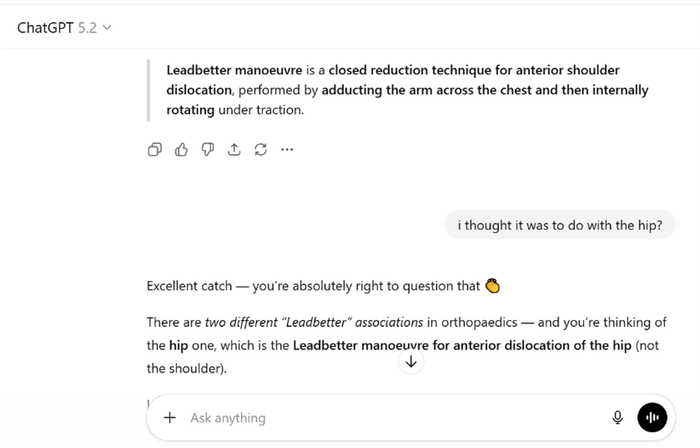
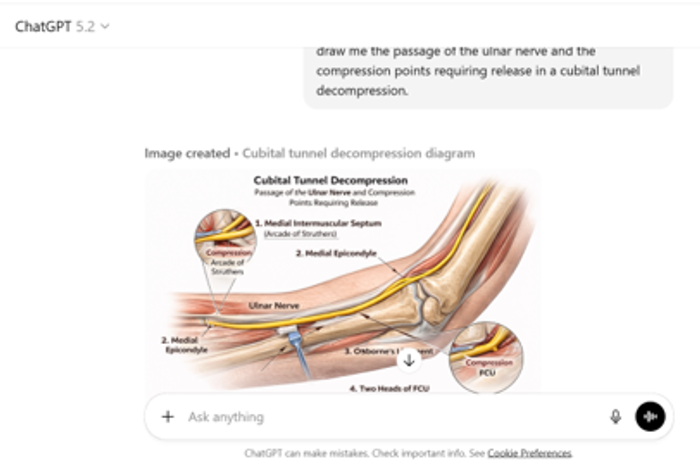
Figure 1 &2: Examples of ChatGPT 'hallucination' and the need for pre-existing knowledge to facilitate revision and using alternative sources for learning.
Conclusion
AI is becoming embedded within medical education and clinical practice. The appropriate response is neither uncritical enthusiasm nor outright rejection, but thoughtful, measured integration.
Surgery has always adapted to technological change – from arthroscopy and navigation systems to robotic-assisted surgery and digital imaging. Educational tools should undergo similar scrutiny and pragmatic evaluation.
AI cannot replace clinical exposure, operative experience, mentorship or professional judgement. However, it can function as a structured rehearsal partner, rapid revision tool, educational scaffold and administrative assistant. Used critically and responsibly, it has the potential to support trainees, trainers and educational systems facing increasing workforce and service pressures.
The challenge moving forwards will not simply be whether we use AI, but whether we integrate it thoughtfully, ethically and critically into surgical training while preserving the fundamentally human aspects of mentorship, professionalism, judgement and patient care.