
From the room where it happens: Reflections on NIHR research prioritisation
Author: Daniel C Perry
From the room where it happens: Reflections on NIHR research prioritisation
Daniel Perry is an NIHR Research Professor and Consultant Children’s Orthopaedic Surgeon at Alder Hey Children’s Hospital, Liverpool and Chair of the NIHR HTA Prioritisation Committee. He is the BOA Specialty Lead for Paediatric Orthopaedic Clinical Trials and a Specialty Editor for the Bone & Joint Journal. Dan is helping to drive a growing portfolio of paediatric trauma and orthopaedic trials www.TOTSresearch.org including FORCE, SCIENCE, CRAFFT, BigBOSS, PICBONE, ODDSocks, OpNonSTOP, BASIS, TOTS, PREPARE and others in development.
The 23rd May 2017 was a strange and sombre day – one I remember clearly as the morning after the Manchester Arena bombing. It felt sobering to arrive at the Royal College of Surgeons of England for a research prioritisation event for trauma – amongst many senior leaders whose minds were dealing with the events that had unfolded the night before. The day was run by the National Institute for Health and Care Research (NIHR), a body that – at that time – I didn’t know too much about. It was a day that would change my career…
Firstly, let me introduce NIHR a little more. Most surgeons have heard of NIHR, but what exactly is it? NIHR is, in effect, the ‘research engine’ of the NHS – responsible for funding and delivering health research that matters to patients and the public, and tasked with ‘Growing the Health and Wealth’ of the nation. It has a budget of around £1.5 billion, roughly 1% of the NHS budget, and has built a solid nationwide research infrastructure – including NIHR-funded research nurses in every NHS hospital – that is, quite simply, unrivalled anywhere in the world. Within NIHR, the biggest pot of project funding is the HTA – Health Technology Assessment – which is the part of NIHR that typically funds the trials we see in surgery and orthopaedics. In fact, 2026 marks 20 years of NIHR, and the scale and ambition of health research in the UK – nowhere more visible than in orthopaedics – has been
transformed as a result.
In May 2017, high-quality surgical trials were still relatively uncommon – and in children’s orthopaedics, they were completely absent. The prioritisation event was an ambitious plan from RCSEng and NIHR to catalyse research in surgery, particularly related to trauma, by identifying the questions that mattered most. In the imposing Surgeons’ Hall (where many of us had our RCS graduations) sat the academic greats of surgery from every specialty, alongside the expert research staff from NIHR. And then there was the orthopaedic table… perhaps a little less academically refined than the rest.
What set the orthopaedic table apart from the others was that we had brought patients – and not just any patient – a 13-year-old boy – which was like bringing a Muggle into Hogwarts. The boy, Evan, had been treated by one of my colleagues at Alder Hey following a serious accident that had left him with multiple broken bones. It seemed right to bring him into the conversation about what research mattered most for children after trauma – and how best to deliver it.
Our table worked through the priorities in orthopaedics and ultimately, one of the focuses was ‘how best to treat distal radius fractures in children’. These were common fractures, routinely managed with surgery, and the British Society for Children’s Orthopaedic Surgery (BSCOS) had already begun discussing that there was genuine uncertainty about how much intervention was really necessary. This became one of the topics that everyone, including Evan, felt mattered. It made the cut. The NIHR team took it away, worked it up, and ultimately commissioned a randomised controlled trial, which became the CRAFFT trial. It is particularly fitting to write this article now because the CRAFFT trial was published in The Lancet last month (www.CRAFFTstudy.org).
To my delight, CRAFFT was not alone – other trials related to children’s orthopaedics, such as FORCE and SCIENCE, also emerged from other NIHR prioritisation processes around that time – each aiming to boost surgical research. Together, these trials helped spark something bigger: a wave of interest and enthusiasm for research in children’s orthopaedics. They helped move paediatric orthopaedics from an evidence-poor subspecialty to one of the most active areas of surgical trials research (www.TOTSresearch.org).
I think about that room often, especially now that I chair the NIHR HTA Prioritisation Committee –and reflect on the opportunity this brings to influence which research gets commissioned, and above all, to breathe life into underserved areas of medicine.
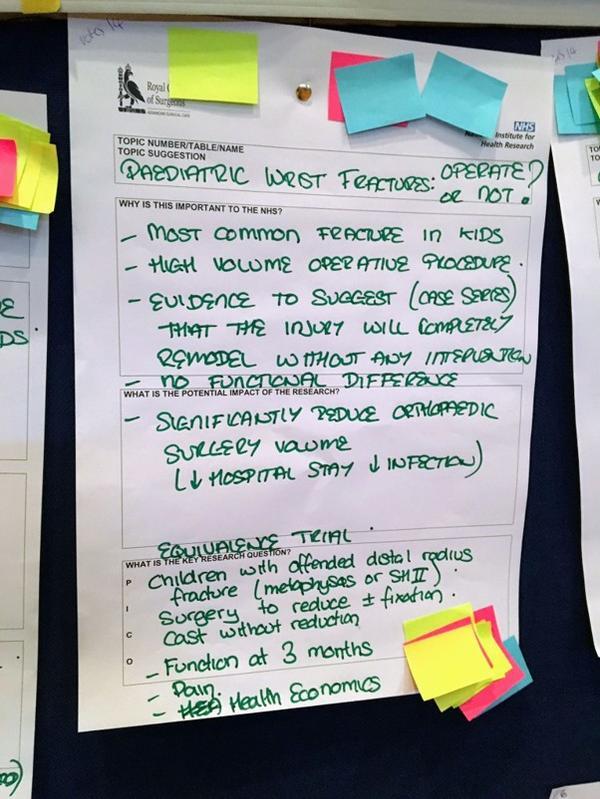
The origin of the CRAFFT Trial, Royal College of Surgeons, 2017.
What prioritisation is – and what it is not
Research prioritisation is the process of identifying where uncertainty exists, where the clinical or societal need is greatest, and where a well-designed study could change practice. It is a way of directing finite resources towards areas where it can have the greatest impact – especially where research might not happen without a deliberate push. That may be because there are few established researchers, because the research is perceived to be difficult, or because the topic is not seen as fashionable or appealing.
Within NIHR, prioritisation operates across several dimensions. It can direct attention to neglected or underserved specialties, as it did in children’s orthopaedic surgery. It can reflect national priorities, such as reducing health inequalities. It can support economic growth by focusing investment in medtech, diagnostics, and life sciences. However, crucially, it can respond to needs identified by patients and families themselves.
Where the priorities come from
Priorities come from many places and we (‘the NIHR’) actively seek areas to prioritise. Within disease areas, priorities can emerge from families, clinicians, advocacy groups, or formal consensus processes. The James Lind Alliance (JLA) Priority Setting Partnerships are perhaps the best-known formal mechanism – bringing patients, carers, and clinicians together to make priorities. However, we also accept suggestions directly through the NIHR website – from families, clinicians, everyone – making the process genuinely open. This breadth matters – because some of the biggest societal health gains come from addressing conditions that might be perceived as ‘minor’, but which affect very many people.
The NIHR staff (‘the secretariat’) working within prioritisation are genuine experts in scanning the healthcare landscape and understanding what is happening in healthcare internationally. They work alongside consultant advisors – usually Public Health physicians – who bring clinical expertise into the heart of prioritisation. Oversight sits with the prioritisation committees, one for primary care, social care, and hospital care. The hospital committee comprises around twenty clinicians from across medicine – spanning pre-hospital, emergency care, and a broad range of medical ‘-ologies’ and surgical specialities. We meet three times per year to discuss areas to prioritise, refine briefs to applicants, and shape the direction of the programme. Every meeting includes analysis of the burden of broad disease areas – years of health lost plotted against research spending – highlighting areas currently underserved, where we may need to particularly focus our efforts.
The responsibility of the Chair
As Chair, my role is to oversee the activity of the Committee and engage more broadly across the HTA programme through a role on the HTA Programme Oversight Committee. The role has given me a deeper understanding of how NIHR functions within the NHS – and of research as both a driver of patient care and a genuine engine of economic growth for the UK. Taking on this role has also brought into focus just how consequential the decisions we make are. The questions we commission will define the evidence base for the next decade. The questions we do not commission may remain unanswered for a generation.
The prioritisation circle
I’m now very aware that the CRAFFT trial exists because prioritisation worked. The TOTS Collaborative exists because prioritisation recognised a gap. Children’s orthopaedics has been changed because prioritisation gave the right questions the chance to become funded trials.
Indeed, my own career has been fundamentally shaped by this process. So, it is a privilege to help oversee it – and to help ensure that other underserved areas of medicine get the same opportunity to grow.
Dan Perry chairs the NIHR HTA Prioritisation Committee and leads the TOTS Research Collaborative (www.TOTSresearch.org). The CRAFFT trial is funded by the NIHR Health Technology Assessment programme.