
Navigating the border: An orthopaedic expert’s manual for medico-legal practice in Scotland
Author: Turab Syed
Navigating the border: An orthopaedic expert’s manual for medico-legal practice in Scotland
Turab Syed is a Consultant Orthopaedic and Trauma Surgeon who operates an NHS and private clinical practice in Scotland (based in Larbert, Falkirk, and Stirling) alongside a high-volume independent medico-legal practice spanning English, Welsh, Scottish, and Channel Islands jurisdictions. He holds formal CUBS (Cardiff University Bond Solon) and UABS CUBS (Aberdeen University Bond Solon) Expert Witness Certificates, is a MedCo-accredited expert, and serves as a Senior Clinical Lecturer at Glasgow Medical School. Additionally, he is an active Council Member for the Academy of Experts and holds a formal appointment as Treasurer for the Scottish Medico-legal Society.
A practical guide for orthopaedic expert witnesses instructed in Scottish civil injury and clinical negligence cases.
For an orthopaedic surgeon whose expert practice has been built within NHS England or Wales, expanding into the Scottish legal framework can feel like step-shifting into an entirely different professional landscape. While the mechanical reality of a complex intra-articular calcaneal fracture or an intraoperative nerve injury remains identical whether it occurs in Birmingham or Edinburgh, the civil court machinery, legal tests, and business mechanics used to evaluate your work change completely.
For any expert looking to handle cross-border work confidently, understanding this unique operational environment is essential.
1. The Court matrix: Court of Session, Sheriff Courts, and ASPIC
When a personal injury or clinical negligence action is litigated in Scotland, it bypasses the English High Court and County Court tracks entirely. Instead, the Scottish civil system operates on a distinct three-tiered model:
- The Local Sheriff Courts: Historically, all low-to-mid-value medical claims were distributed across various regional Sheriff Courts throughout Scotland’s local administrative districts.
- The Court of Session (Edinburgh): Sitting at the pinnacle of the Scottish civil system, this historic court handles the most complex, catastrophic, and high-value clinical negligence claims. Proceedings here are formal, tightly managed, and overseen by a senior judge known as the Lord Ordinary.
- ASPIC (All-Scotland Personal Injury Court): Established in Edinburgh to streamline modern civil litigation, ASPIC is a specialised, nationwide court designed specifically for personal injury actions. It features dedicated personal injury Sheriffs, maintains a country-wide jurisdiction, and enforces highly efficient, ‘front-loaded’ timetables that demand fast administrative responses from your private practice team.
2. Linguistic nuances: Pursuer, defender, and solatium
Before analysing a Scottish case file, you must master the local dialect of the court. If you default to English templates, your reports will immediately look out of place to a Scottish solicitor.
In England, you are accustomed to analysing a claim brought by a Claimant against a Defendant. In Scotland, these actors are strictly referred to as the Pursuer (the patient pursuing the action) and the Defender (the surgeon or health board defending it).
Similarly, financial compensation awarded for physical pain, suffering, and permanent loss of amenity is not called ‘General Damages’. In any report destined for a Scottish court, this must be termed Solatium.
The 10% uplift paradox
You must also remain acutely aware of a significant mathematical trap regarding valuation. Following the Jackson reforms in England, a mandatory 10% increase was applied to all English General Damages awards to balance changes in how legal success fees are recovered. Because those specific funding mechanics do not exist in Scots Law, the 10% increase does not apply. While Scottish judges frequently read the English Judicial College Guidelines (JCG) to find a reasonable baseline for an orthopaedic injury, they are legally required to ‘strip back’ that 10% uplift. As a result, an identical ankle or wrist injury may carry a slightly lower baseline paper value under Scottish Solatium than it would south of the border.
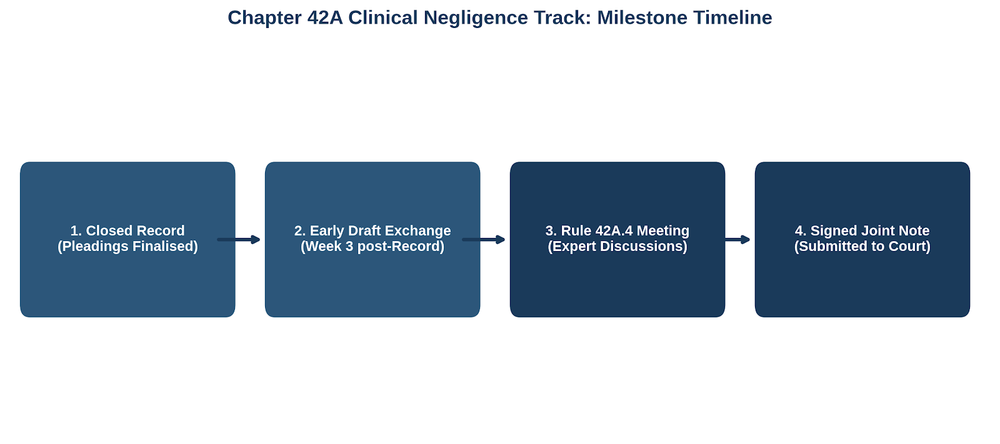
Figure 1: The structured milestone timeline for expert witnesses navigating Chapter 42A clinical negligence tracks.
3. Deconstructing Hunter v Hanley: The Scottish test for negligence
When an English solicitor asks for your opinion on surgical negligence, your mind automatically defaults to the familiar twin pillars of Bolam and Bolitho. You assess whether the surgeon’s choices would be supported by a ‘responsible body of medical opinion’ and whether that opinion has a logical basis. In Scotland, however, Bolam and Bolitho carry no legal standing. Civil clinical negligence in Scotland is governed entirely by the historic landmark case of Hunter v Hanley [1955]. Decided by Lord President Clyde in the Inner House of the Court of Session in 1955 – two full years before McNair J established the English Bolam test in 1957 – Hunter v Hanley demonstrated the progressive nature of Scots jurisprudence by establishing a strict, sequential ‘Triple Test’ that every expert report must address in order:
i. Is there a usual and normal practice? You must prove that there is a standard, widely accepted approach to this specific surgical challenge within the orthopaedic profession.
ii. Did the doctor fail to adopt that practice? You must show that the defender clearly deviated from that established clinical baseline.
iii. Was the course adopted one which NO professional of ordinary skill would have taken? You must confidently state that the path chosen by the surgeon was one which no ordinary, careful doctor, acting with basic professional skill, would have taken had they been acting with ordinary care.
This third pillar represents a remarkably high hurdle. In everyday language, it means it is never enough to state that you would have placed retractors differently, or that you prefer a different locking plate. To satisfy a Scottish court, you cannot simply point to a poor outcome or a difference in technical preference; you must be prepared to state that the defender’s surgical choice was entirely indefensible to any ordinary, careful colleague.
Why Hunter v Hanley and not Bolitho?
Lord President Clyde explicitly highlighted the third pillar as being ‘of crucial importance’. The Scottish court introduced this standard to correct a flawed trial jury direction regarding ‘gross negligence’, establishing instead an objective clinical test. Crucially, Lord Clyde recognised that medicine requires scope for genuine differences of opinion; thus, the third pillar ensures that
a surgeon is never deemed negligent merely for trying a novel technique or deviating from routine protocol, unless that choice was indefensible to any ordinary, careful peer.
Orthopaedic experts frequently ask why Scottish courts do not apply the English Bolitho modification. In English law, Bolitho [1997] was necessary to correct Bolam, which had become overly deferential to doctors by allowing any ‘responsible body’ of peer opinion to exonerate a defendant unless a judge found it logically indefensible.
In Scotland, that judicial ‘correction’ was never needed because Lord President Clyde had already built ‘Bolitho logic’ directly into Hunter v Hanley forty-two years earlier. Furthermore, while the English model asks, “Is there a logical group of doctors who agree with you?”, the Scottish model asks, “Did you depart from standard practice in a way that no careful professional can defend?” This makes Hunter v Hanley a far more structured, objective tool for evaluating surgical technique.
4. Procedural mechanics: Chapter 42A and Joint Notes
How your report is handled after submission is heavily influenced by Chapter 42A of the Rules of the Court of Session. This is a specialised, ‘heavy-touch’ case management track explicitly designed to eliminate litigation surprises.
Under Chapter 42A, the court actively forces a ‘cards on the table’ approach early in the timeline. You will be required to submit your reports in draft form far earlier than you would in a typical English claim.
Furthermore, the judge will routinely mandate a formal Joint Meeting of Experts under Rule 42A.4. You will be instructed to meet directly with the defender’s expert orthopaedic surgeon to map out your arguments. The mandatory output of this meeting is a coauthored, signed Joint Note. This document requires you to clearly outline exactly where your clinical views overlap, where they
disagree, and the detailed clinical reasons behind those disagreements. This eliminates ambiguous fence-sitting and prevents either side from introducing sudden tactical medical theories at the final trial (referred to in Scotland as a Proof).
5. Admissibility, standing, and the ‘skilled witness’: Kennedy v Cordia
Your legal standing to even offer an opinion in a Scottish court relies on the Supreme Court case of Kennedy v Cordia [2016]. In plain language, your evidence must pass four strict tests:
- Necessity: The judge must truly need your specialised orthopaedic knowledge to interpret the facts.
- Admissibility: You must hold the appropriate credentials (such as your FRCS Orth) and active clinical experience.
- Impartiality: You must be entirely independent – not a ‘hired gun’ for the side paying your bill.
- Reliability: Your view must be anchored to a reliable, proven body of medical science, not a personal hunch.
Historically, an expert appointed to assist a Scottish court was known by the deeply gendered title ‘Man of Skill’. This phrase was not merely descriptive; it reflected a systemic legal doctrine across the United Kingdom where women were excluded from entering the legal and medical professions. In Scotland, the landmark case of Hall v Incorporated Society of Law Agents [1901] saw the Court of Session rule that women were not legally considered ‘persons’ under the Law Agents Act, barring them from qualifying as solicitors. In England and Wales, the common law principle of stare decisis et non quieta movere – to stand by decisions and not to disturb settled matters – received a similarly rigid application in Bebb v Law Society [1914] 1 Ch 286, where the Court of Appeal refused to allow women onto the roll without an Act of Parliament.
When the Sex Disqualification (Removal) Act 1919 finally broke these barriers, the Scottish legal system proved distinctly progressive: Madge Easton Anderson was admitted as a solicitor in Scotland in 1920, becoming the very first female solicitor in the United Kingdom (predating England’s first female solicitors by two years). Shortly thereafter, Dame Margaret Kidd KC became the UK’s first female advocate in 1923.
Modern Scots Law has consciously purged its archaic terminology. Under contemporary Court of Session Rules, the term ‘Man of Skill’ has been replaced with the gender-neutral Skilled Witness or Skilled Person. This shift re-establishes the role as an entirely meritocratic one, where expert evidence is judged solely on the objective criteria of Kennedy v Cordia rather than historic legal custom.
6. The structural divide: No MedCo and direct instructions
South of the border, the world of low-to-mid-value personal injury claims is heavily gatekept by MedCo. English practice requires formal MedCo accreditation, strict training pathways for experts, and a landscape thoroughly dominated by massive national Medical Reporting Agencies (MRAs) acting as middle management between the solicitor and the surgeon.
In Scotland, MedCo simply does not exist. There are no state-mandated regulatory portals, no compulsory expert accreditation exams, and national reporting agencies have a virtually non-existent operational footprint. Instead, the Scottish system relies almost entirely on direct instructions. Scottish law firms identify, vet, and instruct independent orthopaedic experts directly based on their professional reputations, academic appointments, and clinical standing.
7. Administrative realities: The limitation trap
This direct relationship means the administrative pressure on the expert is significantly higher due to how the three-year legal deadline (limitation) is handled. In England, a solicitor stops the three-year clock the moment they file a Claim Form and the court issues it. The solicitor then gets a comfortable four-month administrative cushion to formalise and serve those papers on the defendant.
In Scotland, the law is completely unforgiving: the three-year clock only stops when the Summons is formally, physically served on the Defender.
Because a Scottish solicitor cannot safely serve a writ alleging medical negligence without a signed, supportive expert report in hand, a late report near a deadline can cause the entire action to become permanently time barred. When a Scottish instruction crosses your desk with a looming deadline, it demands immediate priority over English cases.
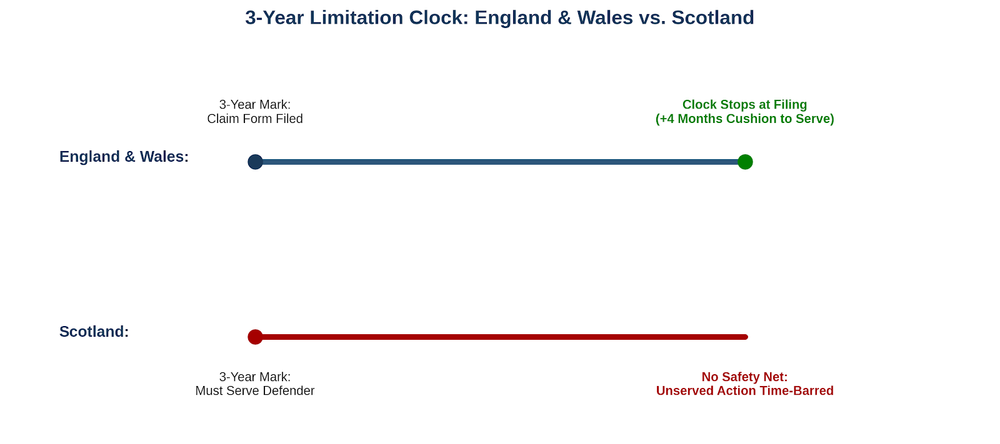
Figure 2: Visualising the vanishing safety net: The critical operational difference between English filing and Scottish service deadlines.
8. Commercial protections: Securing your business practice
Because you are dealing directly with law firms rather than a balancing agency, you carry direct commercial risk. It is an unfortunate, recurring anecdotal experience among independent experts that certain firms will attempt to delay, discount, or completely withhold payment simply because your final report turned out to be non-supportive of their case.
To eliminate this vulnerability, your practice must implement an absolute commercial gatehouse: comprehensive Terms & Conditions must be physically or digitally signed by the instructing firm before you review a single medical record or examine a patient.
Your signed business terms should explicitly dictate:
- Fixed hourly rates or a fixed fee report: Clear fees (e.g., £450/hour) for record review, examinations, joint meetings, drafting and attendance at court.
- Payment independent of outcome: Explicit wording stating that fees are due strictly for your time and objective analysis, regardless of whether your view helps the pursuer or defender.
- Fixed settlement windows: Invoices must be paid within 30 to 60 days of report delivery – never deferred until the conclusion of the lawsuit or the recovery of outlays from the court.
- Solicitor liability: Confirming that the instructing firm holds primary joint and several liability for your fee, preventing them from passing the risk onto an unfunded client.
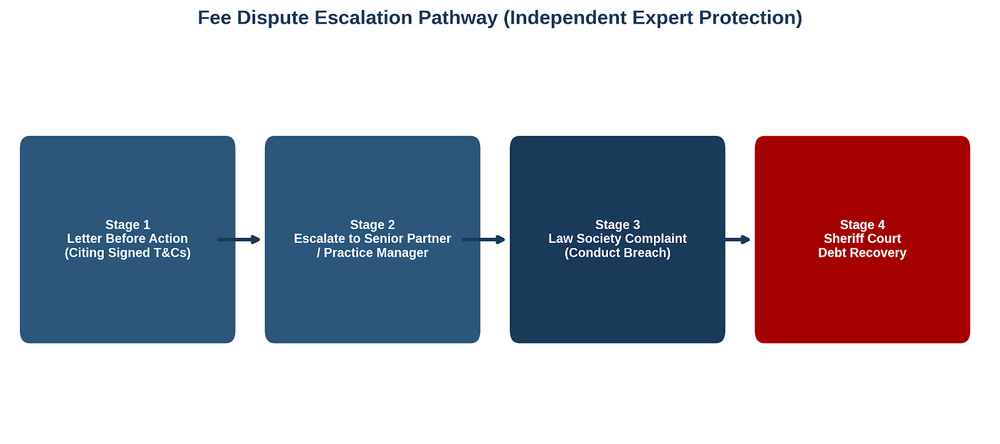
Figure 3: A structured recourse workflow for independent experts handling fee disputes following a non-supportive report.
9. Shielding your integrity: ‘Not a hired gun’
If a solicitor pressures you to soften an unfavourable opinion or refuses to pay because they dislike your findings, your shield is your absolute duty to the court.
As reinforced by Kennedy v Cordia, you are a Skilled Witness – not a hired gun. Your primary, overriding duty is to provide independent, impartial truth to the court, irrespective of who pays your invoice. Altering a clinical conclusion to support a weak claim violates your duty to the judge, misleads the court, and directly breaches GMC professional standards.
If a firm refuses to honour a signed contract following an adverse report, your recourse is clear:
- Stage 1: Issue a formal Letter Before Action (LBA) citing the pre-signed business terms.
- Stage 2: Escalate the matter directly to the firm’s Senior Partner or Practice Manager.
- Stage 3: File a formal conduct complaint with the Law Society of Scotland for breach of professional standards.
- Stage 4: Initiate debt recovery or Simple Procedure proceedings through the Sheriff Court.
By maintaining ironclad, pre-signed business terms and steadfastly reminding instructing agents that your clinical expertise belongs to the court rather than their balance sheet, your independent practice will remain both commercially secure and ethically irreproachable across both sides of the border.
Key learning points
- Adopt Scottish Terminology: Use Pursuer, Defender, and Solatium, and remember that English 10% Jackson uplifts do not apply in Scotland.
- Apply Hunter v Hanley: Structure breach of duty opinions around the three sequential pillars, remembering that a deviation must be indefensible to any ordinary peer.
- Respect Case Management: Prepare for early draft exchanges under Chapter 42A and approach court-ordered Joint Notes with extreme precision.
- Treat Service Deadlines with Urgency: Recognise that Scottish limitation clocks only stop upon formal service, making late reports fatal to a claim.
- Enforce Pre-Signed T&Cs: Secure signed business terms before undertaking work to guarantee payment independent of outcome and protect your overriding duty to the court.
References
- Hunter v Hanley [1955] SC 200.
- Bolam v Friern Hospital Management Committee [1957] 1 WLR 582.
- Bolitho v City and Hackney Health Authority [1997] 3 WLR 1151.
- Kennedy v Cordia (Services) LLP [2016] UKSC 6.
- Hall v Incorporated Society of Law Agents [1901] 3 F 1059.
- Bebb v Law Society [1914] 1 Ch 286. www.lawscot.org.uk/members/journal/issues/vol-64-issue-08/first-lady-of-the-law.
- Rules of the Court of Session 1994, Chapter 42A & 43.
- Prescription and Limitation (Scotland) Act 1973.
- Judicial College Guidelines for the Assessment of General Damages in Personal Injury Cases (17th Ed.).