
The importance of National Joint Registry data quality and audit – Recognising excellent and consistent data quality
Authors: Derek Pegg, Maggie Tate, Rebecca Swinson, Chris Boulton and Timothy Wilton
The importance of National Joint Registry data quality and audit – Recognising excellent and consistent data quality
Derek Pegg is a Consultant Trauma and Orthopaedic Surgeon in Mid Cheshire Hospitals Foundation Trust, Leighton Hospital, Crewe. He is Chair of both NJR Regional Clinical Coordinators Committee and NJR Data Quality Committee.
Maggie Tate is a Data Quality Officer for the National Joint Registry and NEC Software Solutions.
Rebecca Swinson is the Associate Director of Performance and Business Planning for the National Joint Registry.
Chris Boulton is the Director of Operations of the National Joint Registry.
Tim Wilton is Medical Director of the NJR. He was a Consultant Orthopaedic Surgeon at Department of Orthopaedics, Royal Derby Hospital, Derby, with specialist interests in knee and hip replacement surgery.
Data quality is the fundamental foundation for reliable implant outcome and surgical performance analysis. Incomplete or selectively missing data, particularly where data are not missing at random, can lead to misleading conclusions with direct implications for patient safety. For registries, sustained improvements in data capture and audit compliance require both technical systems and behavioural incentives. The National Joint Registry (NJR) is constantly striving to maximise data quality. Since financial year (FY) audit 2022/23 the NJR has recognised hospital data quality with a stratified, three-tiered quality data provider awards scheme.
In March 2026, at the last review of the most recent data quality audit FY 2024/25, 71% of hospitals had achieved 100% compliance, while 90% of hospitals had reached 95% compliance or better. As hospitals continue to resolve missing cases, these figures will improve.
This excellent completeness is accomplished by multiple factors including the determination of numerous hospital personnel, particularly the NJR Hospital Data Managers (HDM), Clinical Liaison Leads (CLL), NEC Data Quality Officers and NJR Management Team.
However, there remain a few hospitals that fall well short of safe compliance standards, with the NHS hospitals, as expected, having a greater representation when compared to independent hospitals. Some of which are likely to be due to the added pressures on resources managing acute medical and surgical care.
Brief history of NJR data quality
It is critical to maximise data quality, to allow the most accurate interpretation of any data analysis. The more accurate the data quality the more dependable will be the conclusions from any analysis. The National Joint Registry (NJR) started collecting data in 2003. From its inception it was mandatory for the independent sector to upload procedures, initially hip and knee replacements. However, for the NHS, although there was very strong professional engagement, it was not until 2011 the recording of procedures became mandatory.
Until 2008, NHS data compliance approached but did not quite achieve 90%. By 2012 NHS data compliance in the NJR, when compared to routinely collected administrative data, was ~95%. This administrative data was Hospital Episode Statistics (HES) in England and Patient Episode Data for Wales (PEDW). This gave an indication of the proportion of missing data and how complete each hospital achieved with their data upload. Nonetheless, this did nothing to help hospitals easily establish and correct missing procedures, nor was it able to determine the accuracy of independently funded procedures1.
Therefore, it was decided to establish a formal audit cycle using the NHS Patient Administration System (PAS). The initial audit using the local PAS systems occurred in 2015 looking at hip and knee cases within the NHS for activity in 2014/15. This was then rolled out in 2016 to include all hospitals for the 2015/16 audit cycle.
This resulted in further improvement in procedure compliance on the NJR and allowed hospitals to easily note missing cases and facilitate their upload within an audit cycle.
They are also able to continue to seek out and file historically missing data. An automated system was initiated for hips and knees for the 2018/19 audit year and by the time of closure of the audit cycle 2018/19 period, an overall compliance of 97.9% was achieved. The automated system was extended to all joints for the 2020/21 audit year. All other more recent audit cycles currently remain open.
How to encourage compliance beyond 95%
By 2021 it was noticed that some hospitals would apparently relax their efforts to chase the uploading of missing/correction of records once they had achieved the target of 95% compliance. At the time this was the original minimum requirement to receive an NJR data quality award. The NJR Data Quality Committee felt that there should therefore be a differentiated acknowledgement of those succeeding in reaching 100% compliance from those only ever just making the 95% mark. Thus, the current quality data awards are recognised with a stratified, three-tiered award of gold, silver and bronze, (Figure 1).
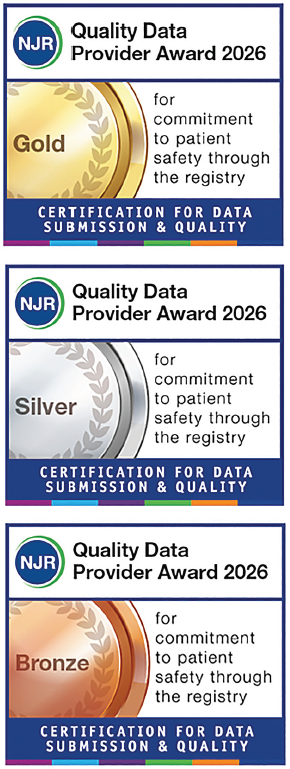
Figure 1: NJR data quality award emblems.
296 hospitals (out of 426) received gold awards for the audit FY2024/25. It is not common in health care, especially working in the NHS that there is ever such formal recognition and credit given by achieving such high standards contributing to patient safety. The hospitals and personnel concerned can be proud of such excellent success2.
The criteria for this year’s 2026 quality data provider awards are slightly more challenging as regards timelines. With hospitals needing to upload a clean set of audit data for FY 2025/26 by 31st August 2026 and complete the audit by 30th September 20262.
Results audit cycle FY 2024/25 reviewed 12 months after the end of the collection period
Hospitals can upload missing cases for a number of years following the end of the collection period. Thus, compliance can improve over time. Figure 2 illustrates the compliance of hospitals achieving the 100%, 95-99% and <95% twelve months after the end of the collection period FY 2024/25. Figure 3 demonstrates the current difference of the NHS compared to the independent sector. 85% of NHS hospitals have a compliance rate of 95% or better while the independent sector has 97% of hospitals with a compliance rate of 95% or greater.
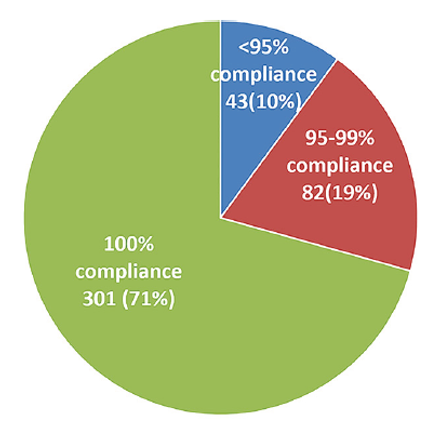
Figure 2: Hospital data audit compliance FY 2024/25 reviewed March 2026.
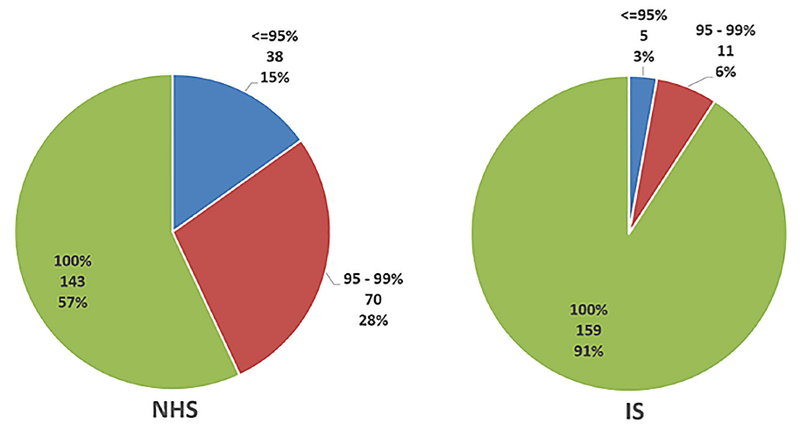
Figure 3: Comparison NHS v Independent Sector hospital data audit compliance FY2024/25, reviewed March 2026.
Figure 4 shows over the last seven audit cycle years how the independent sector has increased the number of hospitals achieving 100% compliance in response to the introduction of the three-tiered stratification of the NJR quality data provider awards. NHS hospitals have also seen an improvement.
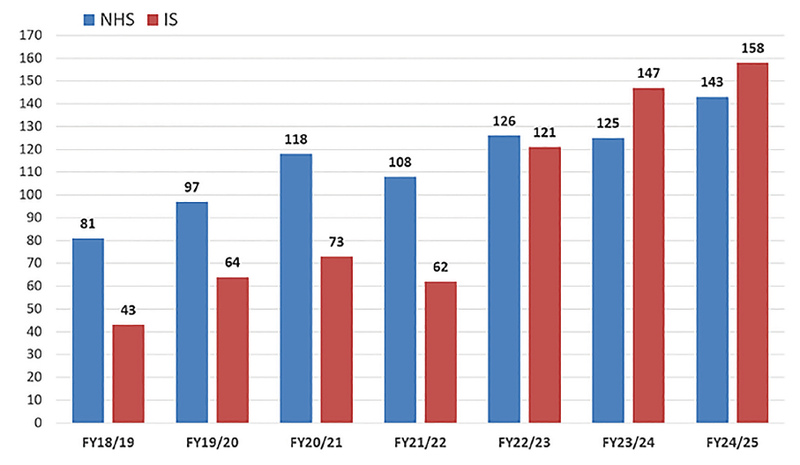
Figure 4: Number of NHS and Independent Sector Providers achieving 100% compliance, reviewed March 2026. Gold/Silver/Bronze awards started FY 22/23.
The number of NHS hospitals/Independent Sector hospitals over the years is approximately a 60%-40% split. While independent sector hospitals currently perform over half of all elective hip and knee replacements3.
As the independent sector is not normally dealing with acute trauma it would be anticipated that their ability to fully engage with NJR data capture is frequently more straightforward. The last three illustrated audit years have seen a significant increase in the number of hospitals achieving 100% compliance when compared with the year before, FY 2021/22.
Some hospitals struggle
Despite evidence that stratification of the NJR quality data provider awards has made significant improvements in compliance, figure 5 illustrates how some hospitals have consistently struggled over the last three years. This is despite considerable NJR support. There are often multiple factors including insufficient resource, including failure to replace critical personnel to the process with retirement, maternity/paternity leave, long term ill health, as well as merger and reconfiguration of trusts and transition to electronic patient records.
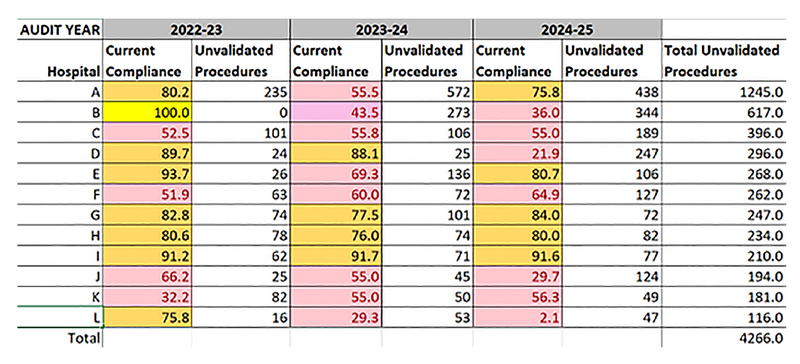
Figure 5: The hospitals with the highest number of missing ‘Unvalidated’ procedures over the last 3 years.
There is an escalation process which the NJR is currently reviewing to help further support hospitals to improve their mandatory data capture.
Compliance is not the only issue that can blunt the ability of the NJR to contribute to patient safety. Consent to data capture for the NJR has been vital from its inception.
Every patient has the right to decline data capture but consent is very rarely an issue for most patients. It can be a particular issue if a field safety notice is raised as regards a particular implant as the NJR is then unable to advise a hospital which of their patients has an implant causing concern. Figure 6 illustrates how some hospitals have a much higher consent ‘No’ than the majority. The NJR compliance officers are constantly trying to assist hospitals in trying to minimise any incorrectly recorded consent ‘No’, unless the patient has genuinely requested that their linked data is to be actively withheld from NJR data collection.
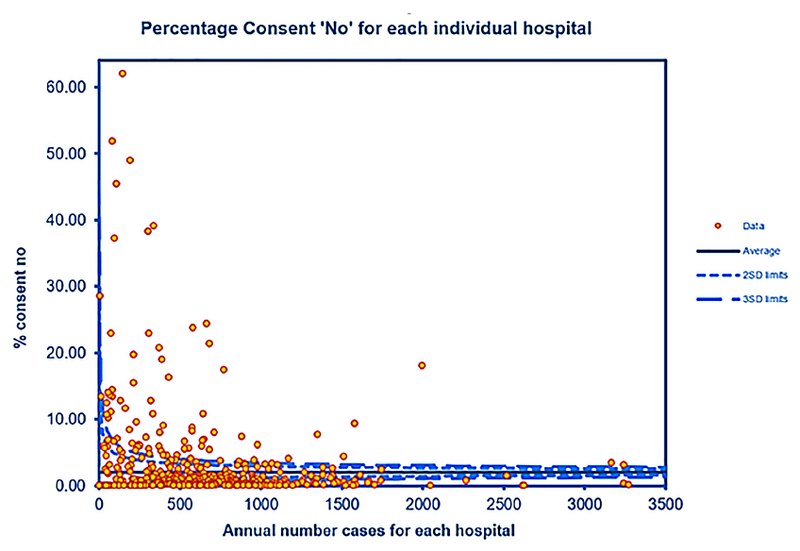
Figure 6: Hospital variability in consent ‘No’ for NJR data capture.
Conclusion
The NJR is fully committed to maximising the quality of data capture. Compliance has improved over the last three automated annual audit cycles. This is associated with three-tiered stratification award – Gold/Silver/Bronze. 100% compliance is seen in 71% of hospitals and 95% or better in 90% of hospitals. However, some hospitals continue to struggle with compliance and consent.
References
- Boulton C, Harrison C, Wilton T, et al. Implementing large-scale data quality validation in a national arthroplasty registry to improve compliance: The National Joint Registry data quality audit programme. Bone Jt Open. 2022;3(9):716-25.
- National Joint Registry. NJR Quality Data Provider Awards 2026. Available at: www.njrcentre.org.uk/healthcare-providers/quality-data-provider-scheme.
- National Joint Registry. 22nd Annual Report 2025. Available at: https://reports.njrcentre.org.uk/Portals/0/PDFdownloads/NJR%2022nd%20Annual%20Report%202025.pdf.